
Research Raises Medication Diversion Concerns in U.S. Jails and Prisons as SPECTROM Introduces Real-Time Accountability
SPECTROM’s OperationalIQ™ tracks controlled-substance transactions, flags discrepancies in real time, and enables
Press Release Disclaimer: This is a press release distributed through the XPR Media network. It has not been independently verified by our newsroom.
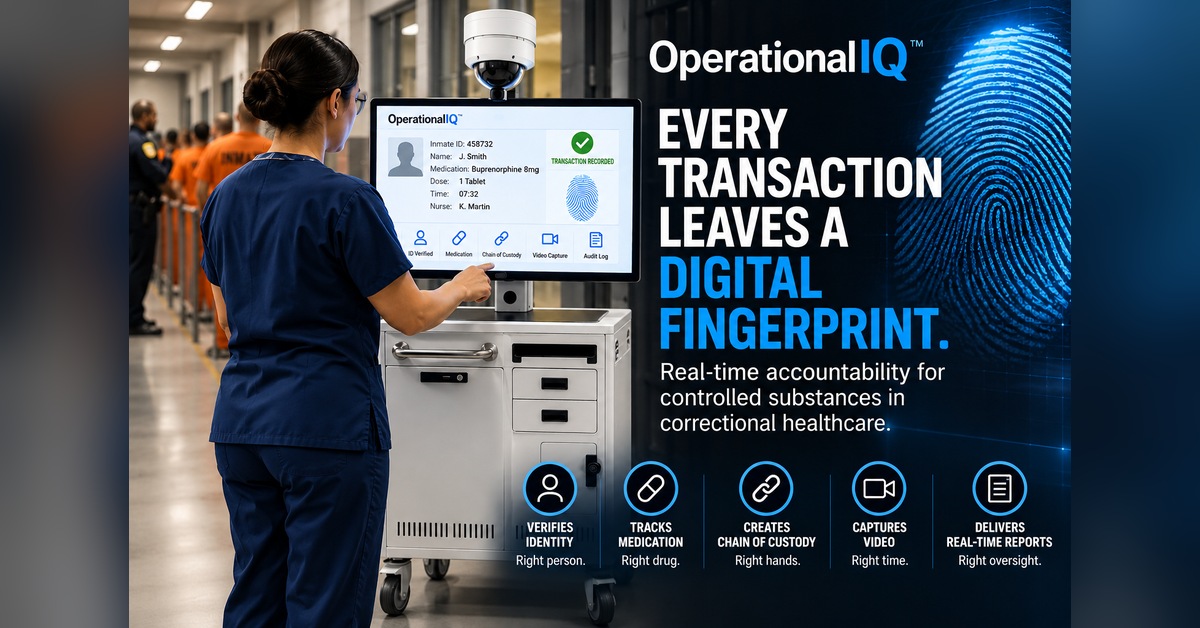

SPECTROM’s OperationalIQ™ tracks controlled-substance transactions, flags discrepancies in real time, and enables correctional leaders to intervene immediately.
SCOTTSDALE, AZ, UNITED STATES, October 24, 2026 /EINPresswire.com/ — SPECTROM has identified a critical gap in how controlled substances are tracked, documented, and monitored throughout the medication-distribution process in America’s jails and prisons. To address that gap, the company is introducing OperationalIQ™, a real-time accountability platform that brings established technology to one of correctional healthcare’s most demanding operations: the daily medication pass, commonly known as the “pill line.”
Every day, correctional facilities administer thousands of prescription medications, including controlled substances used to treat pain, mental health conditions, and opioid use disorder. Yet the movement of these medications through multiple personnel, locations, and handoffs creates accountability challenges that traditional inventory counts, paper records, and delayed reporting do not fully address.
SPECTROM identified that accountability gap and developed OperationalIQ™ to address it.
The platform connects medication tracking, verified staff access, time-stamped records, and management oversight into an auditable digital chain of custody. It integrates barcode-supported tracking, identity-linked transactions, medication-cart connectivity, secure cloud infrastructure, and automated exception reporting. Transactions processed through the platform create records of the activity and associated personnel, helping administrators trace medication movement from inventory through administration and reconciliation.
The critical difference is what happens when something does not reconcile.
Rather than waiting for an end-of-shift inventory count or reconstructing disconnected records after an incident, OperationalIQ™ flags detected exceptions against configured accountability rules and makes them visible in real time. Authorized wardens, healthcare administrators, and designated oversight personnel receive discrepancy information through a secure management portal. They can identify the affected transaction, direct personnel to pause the relevant medication-transfer workflow, secure the medication, investigate the issue, and authorize resumption under facility procedures.
This changes the oversight process from reviewing historical records to responding while an identified issue can still be addressed. It also creates a documented record of the exception and subsequent review, supporting internal investigations, management accountability, and compliance-related recordkeeping.
Importantly, the technology supports immediate staff-directed intervention. It does not claim an automatic electronic lockout or replace required clinical, security, or regulatory procedures.
“After decades of experience in corrections, I believe accountability has to be more than a written policy or an inventory count. When controlled substances move from the pharmacy through a correctional facility to be dispensed, administrators need to know who handled them, what happened during administration, and whether every transaction has been reconciled. Technology gives us an opportunity to establish a much higher standard,” said Steve Bender, M.Ed., CCHP.
The scale of medication administration makes that visibility important. A Sacramento County report documented approximately 16,327 prescription medication doses administered daily across two county jail facilities in fiscal year 2019–20; these were not exclusively controlled substances. New York State separately reported 3,195 incarcerated people receiving buprenorphine or methadone treatment across 42 state correctional facilities as of July 1, 2025. That figure represents patients, not daily doses.
A 2024 U.S. Department of Justice inspector general report identified medication-administration monitoring deficiencies at a federal prison, while published research has documented correctional healthcare staff concerns about diversion.
OperationalIQ™ builds on technology SPECTROM already uses in other healthcare-related settings. The correctional program is entering pilot evaluation, where facility-specific integration, accountability performance, and operational results will be assessed.
SPECTROM’s objective is zero unaccounted-for diversion: documented transactions, visible discrepancies, and investigated exceptions. This is an accountability standard, not a promise that every possible act of diversion can be prevented or detected.
For correctional administrators, the broader opportunity is a consistent view of medication accountability across personnel and locations, with transaction-level information available to support timely decisions rather than relying exclusively on retrospective reporting.
SPECTROM is engaging state corrections departments, county jail administrators, correctional healthcare contractors, and pharmacy leaders interested in evaluating the technology. Pilot scope and timing will be determined collaboratively.
About SPECTROM: SPECTROM applies established technology capabilities to healthcare operations and accountability challenges.
Media and Pilot Inquiries: John Lenstrohm | johnl@spectrom.net | (602) 549-1400
John Lenstrohm
Spectrom, LLC
+1 602-549-1400
Legal Disclaimer:
EIN Presswire provides this news content “as is” without warranty of any kind. We do not accept any responsibility or liability
for the accuracy, content, images, videos, licenses, completeness, legality, or reliability of the information contained in this
article. If you have any complaints or copyright issues related to this article, kindly contact the author above.

Media gallery


